

What is a Private Limited Company?
A Private Limited Company (Pvt. Ltd.) is the most trusted and investor-friendly legal structure for startups in Pakistan. Whether you’re raising capital, hiring a team, or planning for growth, this structure offers limited liability, formal ownership, and legal credibility that simpler setups can’t match.
It is essentially the specific implementation of an LLC under Pakistani law, with features tailored for closely-held ownership. Private limited companies bear the suffix “(Pvt.) Ltd.” with their names. They are “private” in the sense that their shares are not publicly traded on the stock exchange, and there are restrictions on share transfer to keep ownership within a limited group.
💡 Solo founder? You can form a Single Member Company (SMC) under the Pvt Ltd structure.
:: Compare All Legal Structures for Startups
Let’s highlight the characteristics, especially as they compare to other structures and what makes a Private Limited Company well-suited for startups:
Key Features & Shareholding Structure:
A private limited company can be formed with 1 to 50 shareholders. If it has a single shareholder, it’s referred to as a Single Member Company (SMC), and if it has 2 or more (up to 50) it’s a standard private company. It must have at least one director (two in case of a public company, but for private even one director is allowed; usually the shareholders themselves are directors). These companies cannot invite the general public to buy their shares or bonds – funding must come from private arrangements. They also often have preemption clauses in their Articles, meaning if a shareholder wants to sell shares, they must first offer them to existing members (to maintain control within the group).
Liability and Legal Personality:
As covered under LLC, the liability of members is limited to their shareholding. Directors and officers can also generally not be held personally liable for company debts, unless they have breached their fiduciary duties or law (for instance, misfeasance or wrongful trading). The company itself bears liability as a separate entity.
Company Governance & Decision-Making:
Private companies are governed by their Board of Directors and by the shareholders through general meetings. In a small startup, these may be the same people (founders wearing multiple hats). Major decisions like appointing auditors, approving financial statements, or increasing share capital are taken by shareholders in Annual General Meetings (AGMs) or Extraordinary General Meetings (EGMs). Day-to-day decisions are made by the directors (or executives they appoint, like a CEO).
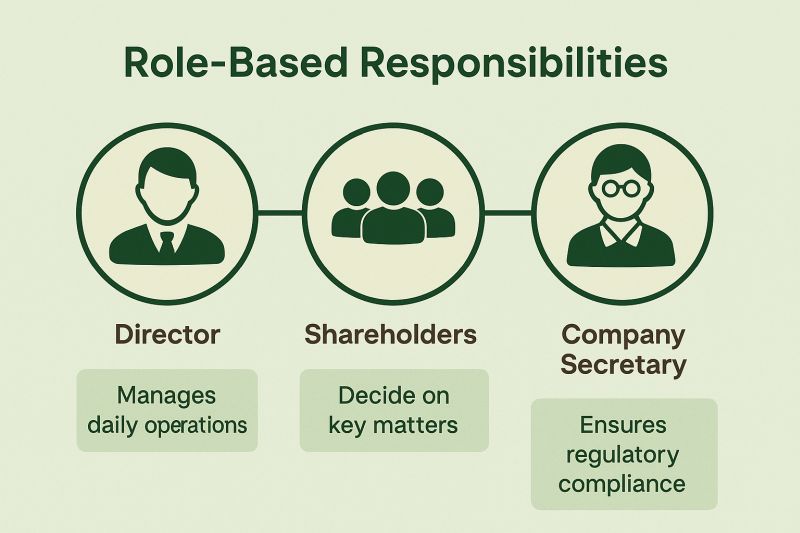
The Companies Act 2017 has built-in protections, such as requiring certain resolutions for issuing new shares (to protect existing ownership from dilution unfairly) and providing rights for minority shareholders (e.g. ability to contest decisions that prejudice them).
An SMC is exempt from holding AGMs (since there’s just one shareholder), but that single shareholder must record important decisions in writing as written resolutions.
SECP Compliance & Legal Obligations:
In addition to annual SECP filings and tax filings, private companies in Pakistan are subject to some specific compliance rules:
- They must appoint a Company Secretary if they are single member companies or if their paid-up capital exceeds Rs. 7.5 million (as per Companies Act rules). The company secretary ensures statutory records and filings are done. For small companies, the secretary doesn’t need special qualifications; often one of the directors or a senior employee can act as the secretary.
- Companies with paid-up capital of Rs. 1 million or more are required by law to appoint a Legal Advisor (an advocate) under the Companies (Appointment of Legal Advisers) Act, 1974. This is often overlooked by small companies, but it is a legal requirement – essentially to have a lawyer available for company’s legal affairs (the threshold is low, so virtually all but the tiniest companies should comply, or this law might be amended in future to apply to larger firms).
- An auditor (chartered accountant) must be appointed to audit the annual financial statements unless the company falls under an exemption category. Under current rules, private companies that are basically small-sized (having share capital below a certain limit and not exceeding certain turnover or employee thresholds) may be exempted from mandatory audit, or allowed to file simplified accounts. However, banks or investors might demand audited financials regardless of size. Public companies and large private companies definitely need audits.
- Any changes in the company (change of address, directors, allotment of new shares, etc.) must be reported to SECP via the appropriate forms (within specified time limits, usually 15 or 30 days of the change). This ensures public record stays up to date.
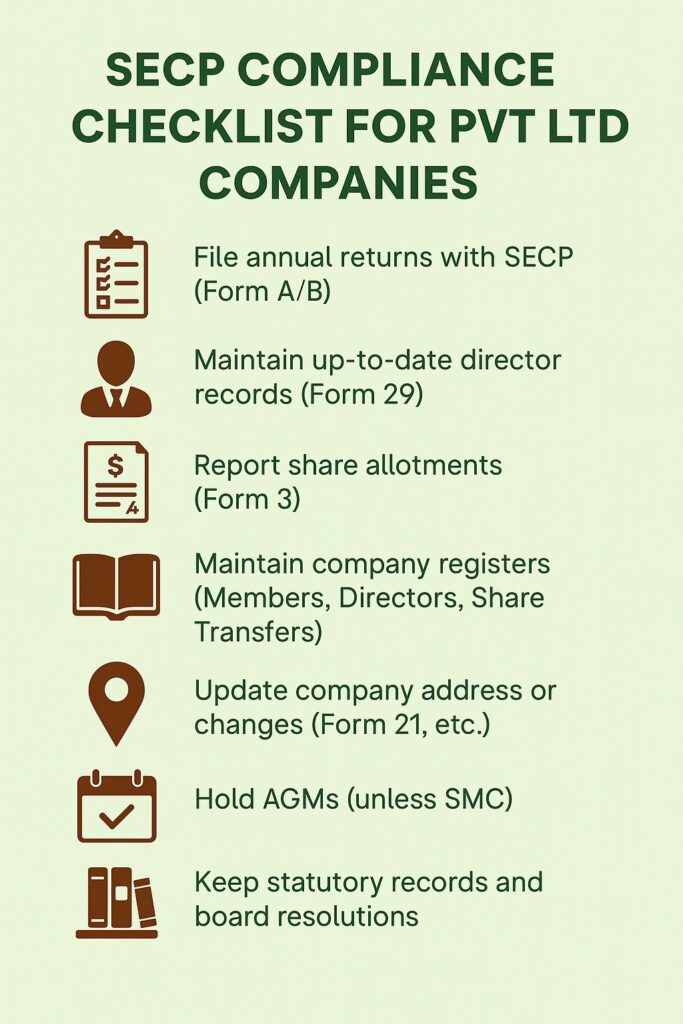
Despite these requirements, for a small startup many of these are manageable and some may not even apply initially (e.g. a two-person startup with Rs. 100,000 capital is technically supposed to have a legal advisor by law, but in practice this is often done when the company grows a bit; an audit might not be required until a certain threshold of sales/assets is crossed). It’s wise, however, to be aware of these obligations early on to avoid penalties.
Why Startups Prefer Pvt Ltd Companies:
Private limited companies are investor-friendly vehicles. Almost all institutional investors (VCs, seed funds) will require the startup to be a private limited company so they can be issued shares in exchange for their investment. It provides a clear ownership structure (cap table), and legal protections around that ownership (via the Companies Act). It’s also easier to value and sell a company’s shares if the startup gets acquired.
For example, if a foreign company wants to acquire your startup, having it as a Pakistani private limited company means the shares of the company can be purchased, which is a straightforward legal transaction. If you were a partnership or sole proprietorship, an “acquisition” would be murkier (the acquirer would have to form a company anyway or take over assets one by one).
Private limited status also adds credibility when dealing with clients. For instance, if you run a tech startup and want to sell services to large corporations or government, operating as “[YourStartup] (Pvt) Ltd.” can smooth procurement processes since larger entities prefer dealing with registered companies (and you can provide a proper NTN, sales tax registration, etc., all tied to your company).
Limitations:
One limitation of a private company is that if you ever want to publicly trade shares (IPO on stock exchange), you must convert into a Public Limited Company and meet stringent requirements. That is usually a later-stage consideration; startups remain private until they reach a mature stage. Also, the restriction of max 50 members means you cannot have too many individual investors – though 50 is a lot for a startup (if you ever have more than 50 shareholders, you’d need to become a public unlisted company at least).
Another point: while raising capital privately is easier as a company, it’s still a process – you must properly issue new shares or create instruments like convertible notes in compliance with company law (share allotments must be offered to existing shareholders first, or they must waive that right, to avoid disadvantaging them – this is handled through pre-emptive rights notices). Many startups handle this by creating new shares and having current shareholders waive preemption so that the new investor can subscribe shares. Legal advice is recommended during fundraising to ensure all corporate actions are done correctly and investor agreements are honored.
Fundraising, Investors & Share Issuance:
Because of the legal structure of private limited companies, investors and banks are much more willing to provide financing. Equity investors gain shareholder rights (e.g. right to vote in meetings, right to dividends, information rights to company records, etc.) which are enforceable under law, giving them confidence. Additionally, private companies can offer stock options to employees as a form of incentive (by issuing new shares or having a pool reserved) – something not possible in a sole proprietorship or simple partnership. All of this makes the private limited company the default choice for high-growth startups in Pakistan.
Unsure which business structure fits your startup? Explore our Complete Guide to Startup Legal Structures in Pakistan to compare your options and choose with confidence.
SMC vs. Multi-Member Company:
If you are a solo founder, you have a choice to set up an SMC (Single Member Company) or bring in one other person (even a family member) to make it a standard private company. SMCs have slightly reduced compliance (no AGMs, and only one director needed), but otherwise largely operate the same way as any company. If you anticipate bringing on a co-founder or investor soon, you might start with a regular private company (with maybe a trusted person holding a single share just to fulfill the “two members” requirement, if you want to avoid SMC complexities of nominee director). However, starting as an SMC is perfectly fine and you can later convert to a normal private company by inducting another shareholder. The SECP even provides a mechanism to convert an SMC to a multi-member company and vice versa.
When a Pvt Ltd May Not Be Right for You:
If your business is extremely small, with no plans to scale or seek investment, and you want to avoid all formalities, a private limited company might be overkill. Also, if you value complete privacy (you don’t want your business existence and basic financials to be on public record at all), you might not prefer a company since some information becomes public (though private companies’ detailed financial statements are not public like public companies, at least basic information is). But for most serious startups, these are minor issues compared to the benefits.
Final Thoughts:
A Private Limited Company offers the structure, credibility, and legal protection that most serious startups in Pakistan need to grow, raise investment, and operate with confidence. While it comes with formal compliance, the benefits far outweigh the effort — especially if you’re planning to scale. Whether you’re a solo founder or building with a team, choosing the right legal foundation today can save you complications tomorrow. If you’re ready to register your company the smart way, PakLawAssist is here to help every step of the way.
More Related:

